The Human Story of Hydrogen at Sea
The harbour at sunrise is a curious place. There is always that brief moment just before the world fully wakes, when the water looks like polished glass and the air is cool and expectant. On one such morning in late May 2025, the yacht Breakthrough slipped out of its berth under that same gentle light, as though the sea had been holding its breath just to see this moment. There was no thunderous rumble of diesel engines no vibration that echoed through the soles of your feet only a sense of quiet possibility. This yacht was powered by something different. Something new. Something that felt, in a way that was hard to describe, like the future.
And for all the world to see, Breakthrough had hydrogen in its heart.
A Quiet Idea With a Loud Impact
The story of hydrogen fuel cells at sea does not begin with this yacht. It begins with people who believed that the old ways had run their course. People who looked at traditional marine engines and saw not only a way of getting from one port to another but a reminder of centuries of pollution and noise. Engineers at ABB, a global technology group based in Zurich and Stockholm, were among the first to ask themselves a challenging question:
“What if a ship could be propelled by something cleaner than diesel? Something silent and true?“
This was not merely an intellectual exercise. It was, in the words of Riccardo Repetto, a chance to build something that would make future generations grateful. “When we really started to think about what hydrogen could do for marine vessels we saw a technology that had remarkable potential,” he said, smiling with the kind of pride that comes from years of hard work. “Not just for yachts but for all kinds of ships.”
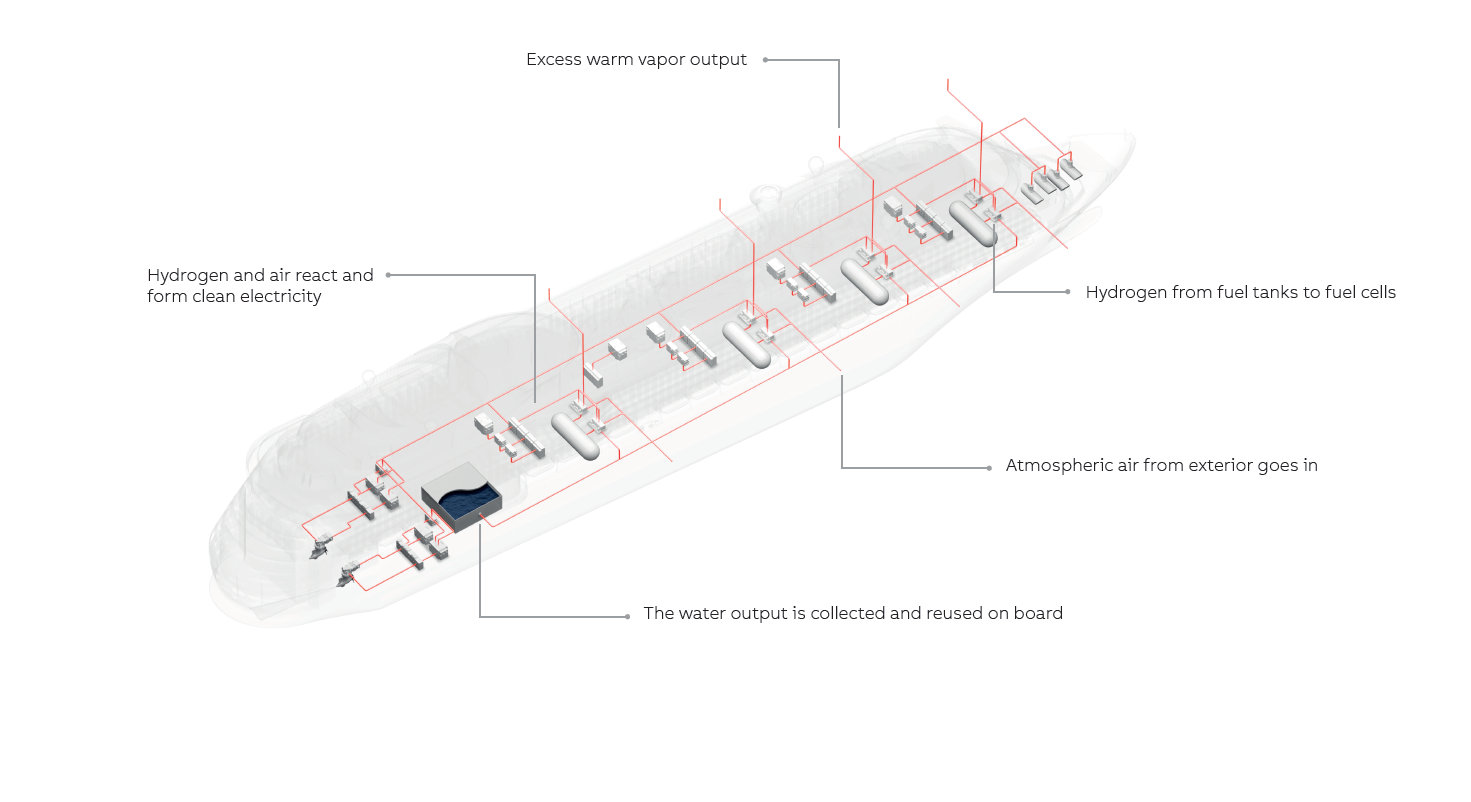
And so began a long, patient journey involving ABB fuel cell technology. For years they worked quietly refining systems originally developed for industrial use adapting them for the unique challenges of life at sea. Hydrogen fuel cells are elegant in principle but unyielding in practice. They combine hydrogen and oxygen in a chemical reaction that produces electricity, heat and only one real by‑product water. No fumes no smoke no lingering smell in the air just pure energy out of a process that leaves the sky a little clearer.
It was a personal quest for many involved. Engineers poured over calculations in dimly lit offices. Specialists in cryogenic storage wrestled with how to keep hydrogen at extremely low temperatures. Electricians drew up wiring diagrams that looked like constellations on blueprints. All the while they worked toward proving that fuel cells were not a fantasy but viable for even the largest vessels.
Friends, Rivals and the Human Beat of Innovation
Not far from ABB’s offices other teams were also experimenting. Companies like Ballard Power Systems in Canada had been working with hydrogen fuel cells for a generation refining stacks that could be used in buses trains and industrial machines. Toyota and Hyundai had already put tens of thousands of fuel cell vehicles on roads around the world. But marine applications remained tricky because the power demands were so much greater comfort systems galley kitchens lifts stabilisers all needed to come from the same source of energy.
This technological puzzle was full of human moments. There were late night phone calls between engineers in Amsterdam and colleagues in Zurich discussions over coffee about whether a particular material could withstand salty sea air arguments about storage configurations that lasted longer than any dinner party should. There were times when the team thought they might be chasing a dream too complex to realise. There was laughter when a prototype once spewed steam unexpectedly and a young technician joked it was “the yacht having a hot bath.” There were tears too when early tests did not produce the hoped for results and the only sound in the lab was the hum of equipment and the slow ticking of time.
Yet somehow, in that mixture of frustration and joy, their work began to converge into something that would change the world of marine transport.
Breakthrough and the People Behind It
By the time the yacht Breakthrough launched people were ready to watch. Feadship a Dutch shipbuilder based in Amsterdam and renowned for crafting some of the world’s most beautiful custom superyachts had taken on the project with daring and pride. Jan Bart Verkuyl, the CEO, would often walk the docks early in the morning talking softly with engineers and builders as though the ship itself were alive and listening. He carried the belief that luxury need not be at odds with responsibility.
The owner of the yacht rarely spoke in public but his quiet commitment to sustainability drove the project forward if this technology could be proven on a vessel so large it might inspire others to follow then the challenge was worth it.
On the day Breakthrough first cruised under hydrogen power there were moments of real human wonder. A child watching from a nearby quay pointed at the yacht and said to her father that it looked like a ship from a dream. Crew members aboard remarked on how still the night felt when the yacht was anchored in a cove and the water whispered against the hull without the usual diesel drone. For a brief moment nature and human ingenuity seemed to meet with perfect harmony.
Ripple Effects and Real Numbers
This is not to say that such technology is inexpensive. Early adopters like this yacht are investing substantial sums to pioneer what others will hopefully take for granted in the future. The installation of a multi megawatt fuel cell system can add tens of millions of pounds to the cost of a vessel, sometimes more if custom engineering is involved. Fuel cell stacks cryogenic hydrogen storage systems power management infrastructure all require highly specialised design and significant labour.
Yet the financial conversation around fuel cells is changing. Traditional engines burn fossil fuels that must be purchased year after year with prices that fluctuate wildly. These fuels contribute to greenhouse gases and regulators around the world are tightening emission standards for marinas inland waterways and even international shipping lanes. Owners and shipbuilders alike are beginning to realise that investing in clean technology now could avoid regulatory penalties and reputational damage later.
Furthermore private owners increasingly find value in quieter operation less dependence on fossil fuels and a narrative of stewardship that resonates with guests and crews alike. Insurance companies are beginning to acknowledge that fuel cell installations produce less vibration and heat than conventional engines and this could eventually lead to more favourable coverage terms. Analysts in London and Singapore have even begun modelling scenarios where operational savings over a decade could offset much of the initial difference in capital expenditure when fuel cells become more widespread and manufacturing scales up.
Sustainability and the Ocean That Listens
Beyond finances one of the most profound impacts of hydrogen technology is environmental. Shipping globally accounts for a significant portion of carbon emissions and nearly all vessels today still depend on burning oil derivatives. When a vessel powered by hydrogen fuel cells glides near a marine reserve or a coral reef the water remains pristine the air clear and the only sound the gentle lap of waves. There is no haze no dark exhaust on the horizon.
Early data from pilot ferries in Norway, vessels developed with support from companies like HDF Energy and classified under guidance from organisations such as Lloyds Register, show that routes previously plagued by pollution are now being traversed without diesel fumes trailing behind. In cities with canals and narrow waterways where tourism and daily life mingle so closely, hydrogen fuel cell powered craft have dramatically improved local air quality.
Communities once resigned to lung irritating exhaust have begun to see a future where their waterways breathe again. Fishermen speak of seeing birds returned to harbours where feedboats no longer puff smoke. Environmental scientists conducting reef surveys note lower stress levels in coral populations near hydrogen vessel routes. In those stories lie the true beauty of the technology its ability to alter not just statistics but ecosystems and human lives.
The Human Energy Behind the Charts
But remember this story is not only about technology. It is about people. It is about the woman in Oslo whose father worked as an engineer on the first hydrogen ferry who told her she was lucky to see such change in her lifetime. It is about a young naval architect in Singapore who stays late into the night drawing new hull forms for hybrid vessels because he wants his children to one day sail across oceans without feeling guilt that their passage harmed the water. It is about crews on yachts who speak of falling asleep under starry skies without engine noise keeping them awake.
There are families who now plan holidays around waterways where fuel cell vessels operate leaving behind tales of old diesel smells replaced by stories of silence. Grandparents tell grandchildren about the first time they saw a hydrogen powered ship arrive under moonlight and how they thought it looked like something from a fairy tale instead of reality.
The pioneers at ABB and their collaborators were quick to point out that this is only the beginning. The development teams at HDF Energy and other innovators in Switzerland and Germany are already refining larger scale fuel cells and modular systems that could be used in cargo vessels passenger liners and research ships. Their chatter in conferences and labs is filled with possibility and a palpable excitement that they are working on something that matters beyond profits.
Where We Stand and Where We Are Going
The technology that felt like a quiet idea a decade ago is now operational. Breakthrough is sailing. Hydrogen fuel cell systems are being tested in ferries. Classification societies have written rules. Governments are offering incentives. Yacht owners are asking shipyards about fuel cells before they even book steel.
Shipbuilders in Germany Italy the Netherlands and Scandinavia are laying plans for next generation vessels that will lean into clean energy as a core feature not an experimental novelty.
It is likely that by the end of this decade hydrogen fuel cell systems will become increasingly common in both luxury vessels and commercial craft around the world. Ports and marinas are beginning to install hydrogen bunkering infrastructure. Investors in Singapore, London, Los Angeles and Rotterdam are openly discussing hydrogen corridors for shipping similar to electric charging networks on land. Universities are launching research programmes with a focus on marine hydrogen safety and integration.
People are already speaking of the moment with a certain kind of warmth. A retired captain in Marseille speaks of watching a hydrogen powered vessel glide past the old port with children waving from the quayside. A marine biologist in Hawaii recalls diving near a reef and seeing cleaner water signals that could be traced to reduced shipping emissions. In clubs where skippers meet for espresso and sea stories sailors compare notes on quiet anchorages where fuel cell yachts have arrived with no noise no smell just the soft sigh of the sea against the hull.
The Quiet Revolution
And so we come back to the harbour at sunrise. The light touches the water first then the hull of Breakthrough. A small wave ripples across the surface a gull cries overhead and a young boy stands with his father, pressing his small hands against the rail, and says that this ship looks like hope made real.
It is, in every sense, the truth. For in the effort of engineers and owners, of innovators and dreamers, the quietest revolution in marine history has already begun. It is a revolution not marked by noise but by stillness not by smoke but by clean air and not by power alone but by the shared human hope that we can cross the seas without costing the Earth. It is the revolution of the quiet engine that spoke volumes.