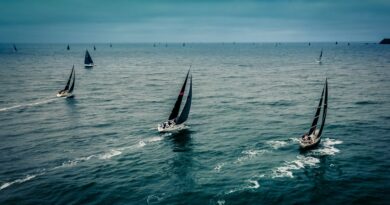
America’s Cup 2024
The 2024 America’s Cup was not simply another contest between expensive yachts and famous sailors. Held in Barcelona from August to October, the 37th edition showed how far the competition has moved from conventional yacht racing towards a hybrid of sailing, aeronautics, data science and high-speed match racing. Emirates Team New Zealand ultimately retained the trophy with a commanding 7–2 victory over INEOS Britannia, but the more revealing story lay in how the boats were sailed, who was given access to the competition and what the event established for the next Cup cycle.
For spectators unfamiliar with modern foiling, the sight of a 75-foot monohull travelling above the water at more than 50 knots could appear almost disconnected from traditional sailing. Yet the defining skills remained recognisable: reading the wind, protecting the preferred side of the course, controlling an opponent and making fewer mistakes under pressure.
New Zealand Turned Innovation Into A Dynasty
Emirates Team New Zealand arrived in Barcelona as defender after victories in Bermuda in 2017 and Auckland in 2021. Its success in 2024 made it the first continuous team to win three America’s Cups in succession.
That achievement reflects more than superior boat speed. The defender controls important elements of each Cup cycle, including aspects of the protocol and class rules, but must still design a boat capable of outperforming challengers who have spent years studying its previous advantages.
The New Zealand team’s AC75, Taihoro, was designed around consistent flight, efficient manoeuvres and performance across Barcelona’s variable conditions. Peter Burling, Nathan Outteridge, Blair Tuke and Andy Maloney formed the principal sailing group, supported by a much larger operation involving engineers, designers, meteorologists, software specialists and shore crews.
The final score suggested dominance, but several races were tactically close. INEOS Britannia became the first British challenger in decades to win races in an America’s Cup Match, taking two consecutive victories after New Zealand had established an early lead. The defender responded without allowing the contest to develop into a prolonged recovery.
That capacity to absorb pressure may have been as important as outright performance. New Zealand did not need to win every start or lead at every mark. It repeatedly recovered through cleaner manoeuvres, stronger positioning and the confidence to wait for an opportunity rather than forcing one.
Britain’s Campaign Was A Breakthrough Despite Defeat
Britain began the America’s Cup in 1851 but has never won it. INEOS Britannia’s appearance in the 2024 Match therefore carried particular historical weight.
Led by Sir Ben Ainslie, the team reached the final after defeating Luna Rossa Prada Pirelli 7–4 in the Louis Vuitton Cup. That result placed a British boat in the America’s Cup Match for the first time since 1964.
The campaign also demonstrated the value of technical partnership. INEOS Britannia worked with the Mercedes-AMG Petronas Formula One operation, applying expertise in aerodynamics, simulation, control systems and high-performance engineering to the design process.
The relationship between sailing and Formula One is not merely promotional. Both sports involve operating a highly regulated machine close to the limits of stability, interpreting large quantities of data and translating simulation into real-world performance. In both, a small improvement may result from hundreds of engineering decisions that remain invisible to the spectator.
Britannia was also the fastest boat recorded during the competition, reaching 55.6 knots. Raw top speed did not overturn New Zealand’s broader advantage, however. America’s Cup performance depends on acceleration, manoeuvring, course position and the ability to remain on the foils through changing wind, not simply the highest figure reached on a straight section of water.
The British result should therefore be understood as both an achievement and an incomplete project. Reaching the Match proved that the campaign had become genuinely competitive. Losing 7–2 showed the distance still separating an effective challenger from a defender capable of controlling an entire Cup cycle.
The AC75 Has Changed What A Sailor Does
The second generation of AC75s used in Barcelona retained the large foiling monohull format introduced for the 2021 Cup. These boats use canting foil arms to lift the hull clear of the water, dramatically reducing drag.
Once airborne, the AC75 behaves partly like an aircraft. Sailors must manage ride height, pitch, foil loading and aerodynamic power while racing within boundaries that can punish even a small loss of control.
The crews are divided between the two sides of the yacht because the large sails restrict visibility and movement. Helms operate from separate positions on port and starboard, making communication essential during tacks and gybes.
The old image of sailors moving constantly around the deck has largely disappeared at this level. Much of the crew remains in protected cockpits, operating controls and producing the hydraulic power required for the sail systems.
Cyclors, who generate power through pedalling rather than conventional arm-driven grinding, became another visible feature of the New Zealand approach. The system had first attracted attention in 2017 and returned across the fleet in Barcelona because legs can produce sustained power efficiently.
This does not mean athleticism has become secondary to engineering. The crews operate under considerable physical stress while processing tactical information at extraordinary speed. A mistake that might cost several metres in an ordinary yacht can result in hundreds of metres lost when an AC75 falls from its foils.
Match Racing Still Matters
The technology can make the America’s Cup resemble a speed trial, but the final remains match racing between two boats rather than a fleet contest.
Each crew attempts to control the other before the start, secure the favoured position and force its rival towards less advantageous wind. The first crossing can determine which boat controls the race, particularly on courses where the boundaries limit tactical freedom.
Foiling changes the consequences of these decisions. A boat sailing in disturbed air may lose aerodynamic power and drop from the foils, turning a narrow disadvantage into a substantial deficit.
At the same time, the speed of the AC75 reduces the time available to respond. Crews must anticipate shifts and crossings before they become visible to a casual observer.
The 2024 Match showed that the fastest-looking boat does not automatically win. New Zealand repeatedly combined sufficient speed with stronger tactical control, while Britain occasionally gained through aggressive starting and improved upwind performance.
For new viewers, the most useful way to follow a race is not to focus solely on the speed display. Watch which boat controls the right to choose its route, which one is forced to tack first and whether either yacht loses stable flight during a manoeuvre.
Barcelona Made The Cup More Accessible
Barcelona gave the competition a different atmosphere from the more contained event held in Auckland during the pandemic-affected 2021 cycle.
The race village and fan areas were free to enter, while racing could be viewed from beaches and waterfront locations. The central position of Port Vell brought the team bases and event infrastructure into one of Europe’s most visited urban environments.
An economic-impact study commissioned after the event attributed more than €1 billion in activity to the Cup and counted 1.8 million visits across the event’s sites. Such assessments should always be read carefully because their methodology may include indirect and induced effects that do not represent money retained permanently by the host city.
Barcelona’s port itself reported a financial loss connected with the event despite the broader claims of economic benefit. This illustrates the difference between citywide economic activity and the balance sheet of an individual public institution.
The stronger case for hosting may lie in international visibility, waterfront activation and the opportunity to develop local marine industries. Even those benefits require comparison with public spending, disruption and the alternative uses of the same resources.
An America’s Cup does not create an automatic economic windfall. Its value depends on how the host integrates the event with existing infrastructure, local businesses and long-term maritime policy.
The First Women’s America’s Cup Was A Significant Addition
The inaugural Puig Women’s America’s Cup was one of the most consequential developments of the Barcelona cycle.
Women had previously participated in America’s Cup teams, but they had rarely been given a dedicated competitive platform connected directly to the main event. In Barcelona, 12 women’s teams raced AC40 foiling yachts, with Luna Rossa Prada Pirelli defeating Britain’s Athena Pathway in the final.
The event gave female sailors access to the high-speed foiling environment from which future Cup crews are likely to emerge. That matters because experience in conventional keelboats does not translate automatically into operating an AC40 or AC75 at extreme speed.
A separate women’s competition is not the same as full integration into the principal America’s Cup crews. The longer-term test will be whether the sailors developed through the programme progress into design, coaching and senior sailing positions across the main teams.
The 2024 event nevertheless created a visible pathway that had previously been missing. For the oldest international sporting trophy, that represented a substantial correction rather than a peripheral addition.
The Youth Competition Built A More Direct Pipeline
The UniCredit Youth America’s Cup was also sailed in AC40s, with Luna Rossa’s youth team defeating NYYC American Magic in the final.
Youth competitions have existed in previous cycles, but the Barcelona format placed young sailors inside the same technical ecosystem as the senior teams. They trained on foiling boats, worked with established organisations and raced in front of the Cup audience.
That experience is particularly important because modern America’s Cup teams recruit from Olympic sailing, professional foiling classes, engineering and specialist high-performance programmes. The route into the competition is no longer limited to conventional big-boat sailing.
The youth and women’s events also offered closer fleet racing than the main Match. With several boats contesting the same course, spectators could see more overtaking, congestion and tactical interaction.
For organisers seeking to broaden the Cup’s audience, these events may prove as important as further increases in AC75 speed.
Sustainability Claims Need To Be Judged Carefully
America’s Cup teams increasingly describe themselves as test beds for sustainable marine technology. The Barcelona cycle included hydrogen-powered support vessels and public commitments relating to clean energy and ocean protection.
There is a credible engineering case for experimentation. Lightweight materials, hydrodynamic efficiency, battery systems and alternative propulsion can eventually influence commercial marine applications.
The environmental footprint of the event remains substantial. Teams transport boats, equipment and personnel internationally, construct temporary bases and depend on carbon-intensive composite materials. Large numbers of visitors also travel to the host city.
Hydrogen chase boats may reduce emissions during particular operations, but they do not make the competition as a whole environmentally neutral. The relevant question is whether technologies proven through the Cup become commercially useful and whether organisers measure the total impact rather than highlighting a small number of visible innovations.
A high-performance sporting event can contribute to technical progress while still carrying significant environmental costs. Both statements can be true.
What Barcelona Established For The Next Cup
New Zealand’s victory gave the defender the right to shape the 38th America’s Cup, which will be held in Naples in 2027.
The next cycle retains the AC75 but introduces technical changes intended partly to contain costs and improve participation. Using an established class reduces the need for teams to begin again with an entirely new concept, although competitive campaigns will remain extraordinarily expensive.
INEOS Britannia’s successor, GB1, acts as Challenger of Record, giving the British organisation a formal role in negotiating the next protocol with the defender. Luna Rossa will compete on home waters in Italy, increasing expectations around a team that has repeatedly approached the final without winning the trophy.
Naples offers a different sailing environment from Barcelona, with local wind patterns and coastal geography likely to influence design and training. Teams will need to determine which lessons from 2024 remain transferable and which were specific to the Mediterranean conditions off Catalonia.
The central competitive question will be whether any challenger can close the organisational advantage New Zealand has accumulated across three consecutive victories.
Why The 2024 Cup Mattered
The 2024 America’s Cup did not produce the close final suggested by the build-up. New Zealand remained clearly superior when the trophy itself was contested.
Yet Barcelona still marked a meaningful evolution. Britain returned to the Match after 60 years, AC75s passed 100 kilometres per hour in competition, women received their first dedicated America’s Cup regatta and youth sailors were given a clearer route into the foiling generation.
The event also demonstrated the continuing tension at the centre of the Cup. It is both sailing competition and engineering arms race, public spectacle and private contest, historic trophy and experimental technology platform.
That tension is part of its fascination. The America’s Cup survives not because it preserves sailing exactly as it was in 1851, but because each defender is allowed to redefine what the fastest and most advanced form of match racing should look like.
Barcelona’s answer was a competition in which boats flew, software and simulation shaped performance, and New Zealand’s combination of engineering depth and racing judgement remained unmatched. Naples will now have to determine whether that dynasty can finally be broken.